



|
|
G.H. Hofmeester
Philips Corporate Design
PO. Box 218
5600 MD Eindhoven
The Netherlands
+31 40 2732302
J.A.M. Kemp
Philips Research
Institute of Perception Research / IPO
PO. Box 513
5600 MB Eindhoven
The Netherlands
A.C.M. Blankendaal
Delft University of Technology
Faculty of Industrial Design Engineering
Jaffalaan 9
2628 BX Delft
The Netherlands
Users were involved at an early stage of the design process. Based on information gathered in a series of interviews two pagers were designed. In an evaluation both models were perceived as significantly more sensual than a reference model.
The way users experience interaction with a product has many dimensions. It is assumed that sensuality is one of the positive feelings influencing our perception. Therefore, we think sensuality can play a role in the experience of a product. Since it is assumed that this feeling is positive, it can increase the pleasure involved in using the product. The designer can influence the way feelings are induced by a product. The designer "has powerful abilities to convey complex, non-obvious information using shape and colour" [4].
The method used in this project can help the designer to create a product which induces a particular feeling for a specified target group. This was done by involving potential users at an early stage in the design process and by keeping them involved during the evaluation phase. When used in an iterative process, this early user involvement provides the designer with a tool to monitor feedback on the design as it progresses. Research done at Philips Corporate Design to investigate pleasure in the use of products provided the background for the research methods.
A pager was chosen as a carrier for developing our approach for two reasons:
1. A pager is a device you wear close to your body, and the body is an important factor in relation to sensuality.
2. A pager allows communication with other people. Action and reaction are important aspects of a sensual interaction.
A pager is a portable communication device, which can receive personal messages through radio broadcast. Pagers for personal use are thought to be an emerging market. Form-giving can play an important role in user interface design [4]. In the design of a pager, the product"s shape and colour is seen as part of the interaction design. In a small personal product like a pager, the interaction isn"t limited to the retrieval of messages, but extends to the complete handling of the product and the feelings that are involved in that.
The target group chosen was women aged 18 to 30 years. This group was interesting for two reasons:
1. We were interested in designing for private as opposed to professional use (a younger audience was thought to be more appropriate for this type of use).
2. Women were chosen because current pagers are targeted at a male audience.
Thus, the objective of this project was to design a pager for women aged 18 to 30 years, which induces a sensual feeling. For Philips this was an exploration (it was a graduation project) to learn about how to design products that induce particular emotions.
Even though sensuality has been described in many ways, a clear definition could not be found in these surveys. Frijda [1] for example, describes sensuality as being charmed or fascinated, being in love, feeling desire, lustful, excited, feeling pleasure and satisfaction. Because there are so many ways of describing sensuality, it was decided not to define this term for the first series of interviews. The subjects in these investigations were presented only with the term "sensuality" (In Dutch the term "erotiek" was used, but this was not translated into the English word "eroticism" because, according to us, "sensuality" comes closer to the Dutch meaning of "erotiek"), thus leaving it open for their own interpretation. The terms that came up in the first series interviews were used to investigate how sensual the final design concepts were perceived to be.

Figure 1 Overview of the design process.
The subjects were asked to bring objects they experienced as being sensual. The interview was divided into two parts. In the first part the subjects were asked to name, as precisely as possible, product properties that could induce a sensual feeling inspired by the objects they brought with them. In the second part of the interview the interviewer explained the functionality of an alphanumerical pager without showing the device or naming it. The subject was asked to imagine a pager that can bring about a sensual feeling. Finally the subjects were asked to rate the properties they had named according to their importance.
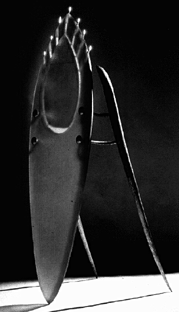
Figure 2 A candelabra that was brought to one of the interviews.
properties                                    frequency

organic, human, body                                 14
smooth                                               13
handsize, fitting comfortably in the hand            12
warmth                                               12
caress, skin close                                   12
flow, swell, rise, expand                            11
nice feeling, protuberance, lumpy, irregular, hole   11
rounding, curve                                      11
soft                                                 10
flexible, malleable, elastic                         10
pleasure, nice, enjoying                              6
wearing on the chest                                  7
wearing in the pocket                                 5
Figure 3 The properties causing a sensual feeling that were most often mentioned. The right column shows the number of times the properties from that category were mentioned in all the interviews.
objects                                           score

soft                                                 74
caress, skin close                                   55
smooth                                               54
slope, slightly curved, firm line, thick-thin        47
rounding, curve                                      46
shiny, glossy, reflection                            35
flexible, malleable, elastic                         34
warmth                                               31
heavy, sagged shape                                  26
contrast in colour                                   23
Figure 4 The 10 object properties causing a sensual feeling that were rated highest. Score refers to the total sum of the ratings. The ratings per property range from 12 to 1 (12 for the most important).
pager                                             score

organic, human, body                                 54
warmth                                               54
wearing on the chest                                 53
handsize, fitting comfortably in the hand            48
smooth                                               40
hard                                                 34
heavy, sagged shape                                  32
flow, swell, rise, expand                            30
nice feeling, protuberance, lumpy, irregular, hole   29
warm light colour, red                               24
Figure 5 The 10 pager properties causing a sensual feeling that were rated highest. Score refers to the total sum of the ratings.
Because "sensuality" can be seen in so many different ways, it was necessary to form groups of properties that indicate different preferences. To indicate this differentiation a correspondence analysis was performed on the data. The analysis produced three factors. Factors can be seen as axises in a 3-dimensional space in which all the properties are mapped (figure 6). The properties that all the subjects thought to be important are in the middle. The more extreme properties have more distance from the centre. We defined each of the factors by two clusters of properties that represent the extremes of each factor. Thus this analysis resulted in three pairs of clusters of product properties (figure 7).
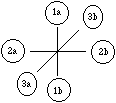
Figure 6 The six clusters of product properties in the 3-dimensional space.
cluster 1a                                    cluster 1b

- vibration                                   - wearing on the arm
- flexible, malleable, elastic                - slope, slightly curved, firm line, thick-thin
- caress, skin close                          - flow, swell, rise, expand
- soft                                        - shiny, glossy, reflection
- handsize, fitting comfortably in the hand

cluster 2a                                    cluster 2b

- flow, swell, rise, expand                   - heavy, sagged shape
- wearing on the chest                        - fabric, satin, plush, velvet
- inwards, alone                              - scent
- secretly, mysterious, unnoticeable          - warmth

cluster 3a                                    cluster 3b

- wearing on the arm                          - countersunk keys
- wearing on the neck                         - slope, slightly curved, firm line, thick-thin
- nice feeling, protuberance, lumpy,          - warm light colours, red
  irregular, hole                             - shiny, glossy, reflection
                                              - scent
                                              - rounding, curve
Figure 7 The properties that form the three pairs of clusters.
In this phase of the design process the definition of "sensuality" proved to be a major obstacle. It is hard to explain this concept to subjects without being too specific.
Twelve collages were made. They represent the six "basic and six "extreme" elements mentioned in the previous paragraph. Input for the collages were the transcriptions of the interviews and the objects the subjects brought with them. The goal was to make the results of the interviews more appropriate for design input by defining atmosphere, colours, shapes, textures and materials. The collages were boards (100x70 centimetres) with full colour images of the objects the subjects brought and images, 3-dimensional shapes and materials the designer related to the properties mentioned.
One factor, representing two pairs of clusters, that seemed to be most appropriate for developing two different concepts, was chosen. This was factor 2 (see figure 7). Two designs were developed on the basis of the two collages of that factor. The collages of the six "basic" properties were used as a reference.
On the basis of these properties and the collages a design was developed. Following is a description of the "extreme" properties and a description of the design. Figure 9 shows a picture of the resulting design.
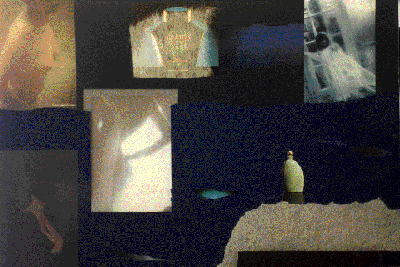
Figure 8 The collage for cluster 2a (design concept 1).
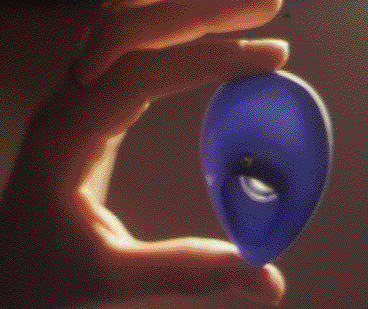
Figure 9 Design concept 1.
When a message is received, the device slowly starts to glow. The user can activate the pager by pressing the metal key on the front of the device. Subsequently, several symbols and numbers will appear on the surface of the pager, depending on the content of the message.
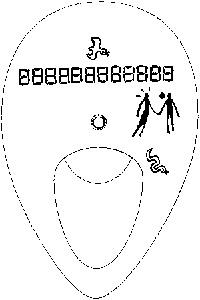
Figure 10 Front view of design concept 1 including the six graphic symbols and twelve digits.
Figure 10 shows the graphic symbols that can represent a message. There are six symbols:
- a bird, which can represent positive, affirmative or happy
- a snake, which can represent negative, or sad
- two human figures, which can light up separately or together, which can represent alone or together, you or me
- a heart, which can represent feeling or leisure
- some lines, which can represent thinking or business.
These symbols are not pretending to be universal, they present an exploration of a non-verbal interface. The user can give them meaning by the way she uses them, the presented meanings are a suggestion from the designer. In addition to these symbols a 12-digit number can be displayed, representing for instance a telephone number or a time for a suggested appointment. By combining these symbols, messages can be composed. For instance, the bird, the two human figures, the heart and a telephone number can mean something like "me and you, happy feeling", or it can mean "Can you call me back to make an appointment in our free time?". In this way, the sender is given the possibility to convey messages with an emotional character and gives the sender the opportunity to use his or her creativity more, compared to a purely numeric interface. The user can scroll through the messages in the memory of the pager by moving her finger over one of the touch areas on the back of the pager. The other touch area can be used to set the alert signals.

Figure 11 The display on design concept 1.
The finish of the pager is a soft-touch paint. Stroking the device as a way of scrolling instead of clicking a key, is a way of trying to enhance this softness.
The alert signal, a light which rises slowly to a maximum, is a characteristic emphasising the "flowing" transition. The glowing of the alert light suggests warmth.
The pager normally hangs upside down on the cord. When the user wants to see the messages, she is likely to hold it in the cup of her hand, close to her. This emphasises an atmosphere of intimacy, relating to "inward, alone". The user can wear the pager close to her body, making it a very personal device. It can be further personalised by using a cord or ribbon to hang the pager on. The pager fits smoothly in the hand of the user, making it personal and also enabling the user to "forget the outside world". The symbols used in the display make it possible to communicate personal messages.
Semi-transparency and a blue colour emphasise the aspect of mystery, according to the subjects. The display is hardly visible when the device is not active. Only the user will know the device is activated by touching the small metal button on the front. The messages, which appear as symbols on the surface of the device, have a meaning connected to the person sending them. They don"t have a prescribed meaning. Because of this, the sender and the user will be the only people able to understand the message.

Figure 12 The collage for factor 2b (design concept 2).
The pager can be clipped to clothes or worn in the pocket or a bag. The gel layer around the hard casing, allows the temperature of the pager to change. The little joystick will move out when a message is detected. It will push against the user"s skin, if the pager is worn on the body. The joystick is used to step through the messages and to select the alert signal.

Figure 13 Design concept 2 with a fabric cover with a zipper..
The interface is auditory, there is no visual display. Basically, it has the same principle as the interface described in concept 1. The graphical icons are replaced by auditory icons, and the twelve digits are replaced by spoken numbers. The auditory icons are based on three instruments: - a clarinet, which is a neutral sound in this case - a cello, representing sad or negative - a flute, representing happy or affirmative. These instruments are played in ascending or descending tones, representing respectively "you" and "me". The sounds can be modified, representing "business" and "leisure". To be able to hear the messages, the user has to hold the pager close to her ear. Other people won"t be able to hear the sounds.
The silicon gel can store and dissipate warmth. When it has not been worn for some time, the pager will feel cold. When wearing it, the pager will become warm and stay warm for some time. This refers to the pager being at body temperature, which was mentioned by several subjects. The colour of the pager is dark red, which was mentioned as a warm and sensual colour.
The pager is covered by fabric, referring to the smooth and skin-like qualities mentioned in the interviews. The cover is made out of two different fabrics, with different textures, making it more interesting to feel. Softness in this pager is a combination of giving way of the surface and a soft surface texture. The gel has the skin-like qualities that were mentioned in the interviews.
The whole pager is designed to be an object that is interesting to touch and play with. The silicon coating, filled with gel, gives it a heavy, bulging shape. The joystick, used as an input method, also has a more sturdy character then the keys that are normally used on pagers. To give the pager a finish which provides a good tactile sensation, it has a fabric cover. This cover can also be used to customise the device; many kinds of fabric can be used.
An instruction sheet explained the set-up of the study and the kind of models that were evaluated. An interviewer introduced the subject and explained how the semantic differentials should be used. Each subject then read a short explanation about what pagers are. Each pager was accompanied by another sheet, explaining the user interface. The pagers were then rated one by one in a random order. A short debriefing ended the session.

Figure 14 The means for the semantic differentials referring to sensuality.

Figure 15 The means for the semantic differentials referring to cluster 2a (design concept 1).
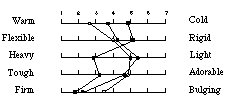
Figure 16 The means for the semantic differentials referring to cluster 2b (design concept 2b).


Figure 17 The user has to hold the pager close to her ear to hear the messages.
Further conclusions from this project are divided into two areas: the process for designing a product that can induce a sensual feeling and observations about the designs.
Using semantic differentials, quick investigations can be conducted to obtain an overview of the rate of success in regard to the items that were used as input for the product design. Only small subject samples are needed to obtain significant results.
Design processes and evaluations are often visually oriented. From the results of the interviews, it can be concluded that attention should be given to tactile and auditory qualities of products to make a design complete and coherent .
Involving users at an early stage of the process can increase the chance that consumer products will induce particular feelings for their users. It can clarify and deepen design briefs, so that a commissioner can define what he wants in a better way and the designer has a broad range of information and input regarding users and their feelings. To fully use this user input, the process of investigation and design should be iterative.
(The design models are protected and the user interface is patented.)
2. Logan, Robert J., Augaitis, S. & Renk, T. Design of Simplified Television Remote Controls: a Case for Behavioral and Emotional Usability, in Proc. Human Factors and Ergonomics Society (1994), 365-369.
3. Nass, C., Steuer, J. & Tauber, Ellen R. Computers are Social Actors, in Proc. Chi"94 Human Factors in Computing Systems (Boston, April 24-28, 1994) ACM Press, 72-78.
4. Smets, G., Overbeeke K. & Gaver, W. Formgiving: expressing the Nonobvious, in Proc. Chi"94 Human Factors in Computing Systems (Boston, April 24-28, 1994) ACM Press, 79-84.