



|
|
Julie Ratner, Eric M. Grose & Chris Forsythe
Statistics and Human Factors
Sandia National Laboratories
Albuquerque, NM USA
E-mail: jratner@sandia.gov
This paper describes a study in which HTML style guides were characterized,
compared to established HCI style guides, and evaluated against
findings from HCI reviews of web pages and applications. Findings
showed little consistency among the 21 HTML style guides assessed,
with 75% of recommendations appearing in only one style guide.
While there was some overlap, only 20% of HTML relevant recommendations
from established style guides were found in HTML style guides.
HTML style guides emphasized common look and feel, information
display, and navigation issues with little mention of many issues
prominent in established style guides such as help, message boxes
and data entry. This difference is reinforced by other results
showing that HTML style guides addressed concerns of web information
content pages with much greater success than web-based applications.
It is concluded that while the WWW represents a unique HCI environment,
development of HTML style guides has been less rigorous, with
issues associated with web-based applications largely ignored.
HTML, World Wide Web, Style Guides, Human Computer Interface
The popularity and prolific expansion of the World Wide Web (WWW)
has fueled an unprecedented growth in the number of developers
creating computer-based materials for public access[2]. Hypertext
Markup Language (HTML) has been the predominant language used
by WWW developers. In the brief existence of the WWW, there has
not been an opportunity for style guides and conventions comparable
to other Human Computer Interface (HCI) domains to first, be developed
and secondly, gain acceptance from the development community,
concerns with the effectiveness of style guides aside [1,3,4].
This predicament is worsened by HTML developers with limited knowledge
of traditional HCI concerns and a general unfamiliarity of many
problems raised by cross-platform and browser compatibility requirements
faced with WWW-based HCIs. To fill these voids, numerous HCI style
guides have appeared for HTML development. This paper provides
a general characterization of internet-accessible HCI style guides
for HTML, a comparison of HTML and established HCI style guides,
and an assessment of HTML style guides based on findings from
usability assessments of HTML-based interfaces.
The intent of this study was to assess the collective knowledge
regarding HCI style components and not to evaluate individual
style guides. Thus, HTML style guides were combined to form a
single, comprehensive set of HCI style recommendations. Recommendations
from established HCI style guides were grouped in the same manner.
To obtain the HTML style recommendations, 21 WWW sites offering
recommendations regarding HCI components of HTML were identified
in the fall of 1995. From these reviews, a set of 357 unique style
recommendations were obtained. Recommendations from established
HCI style guides were collected from five printed sources, with
all recommendations not applicable to HTML discarded. For this
sample, style guides were excluded if specific to a given platform
or operating system. This review resulted in a collection of 270
unique style recommendations.
Characterization of HCI style guides for HTML first looked at
the frequency at which specific recommendations were cited. The
majority of the 357 recommendations (269 or 75%) appeared in only
one style guide. Next, each recommendation was assigned to one
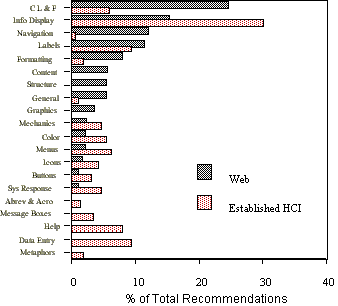
of 20 categories. Figure 1 shows the distribution of recommendations
across categories. Four categories accounted for 63% of the recommendations:
Common Look and Feel (CL&F), Information Display, Navigation
and Labels.
The comparison of HTML and established HCI style guides began
with a consideration of the development process. Ten authors of
HCI style guides, 5 HTML and 5 established, were surveyed. Surveys
revealed distinct differences. All HTML style guide authors were
from educational environments and described the development process
as informal with an average of 3.26 weeks spent writing the style
guide, with revisions prompted by feedback from users or impending
conference submissions. In contrast, none of the established style
guide authors were from educational domains, but from military,
government and corporate organizations. Three of five specified
that a formal process was employed to develop the style guide,
with an average of 54.2 weeks for the initial version, with subsequent
versions following annual reviews and structured working groups.
As shown in Figure 1, the categorization of recommendations reveals
some overlap, but also considerable differences between HTML and
established style guides. A Chi Square test of independence showed
a significant difference in the distributions of recommendations
across categories (X2=245.5, p<0.05; df=19). The biggest differences
arise from the greater concern for information display and consideration
of help, data entry and message boxes within established HCI style
guides. The next comparison assessed the degree to which established
HCI style recommendations were addressed within HTML style guides.
Of the 270 HTML-relevant recommendations found in the established
HCI style guides, only 53 (20%) also appeared within HTML style
guides, with another 20 partially addressed within the HTML style
guides. The greatest overlap occurred for recommendations categorized
as common look and feel (15 of 16), menu design (11 of 17) and
labels (15 of 25).
Figure 1. Distribution of Style Guide Recommendations
Across Categories
As a further assessment of web style guides, user interface design
reviews conducted by human factors practitioners at Sandia National
Laboratories (SNL) for a web-based, corporate information infrastructure
were evaluated to determine the extent to which findings were
addressed within HTML style guides. While reviewers were knowledgeable
of the established HCI style guides, all reviews occurred prior
to exposure to any of the HTML style guides. Findings were drawn
from two separate sets of reviews. In the first, reviewers assessed
web-based applications with HTML-based HCIs. Some of the applications
included were an electronic phone book, tools for accessing financial
databases, and a conference room scheduler. The second set of
reviews assessed pages on the SNL corporate web with purely information
content (e.g., corporate newsletters, engineering procedures,
departmental home pages, etc.). In the review of web-based applications
only 57 of 141 (40%) findings addressed HCI components discussed
in the HTML style guides. In contrast, for web pages with primarily
information content, 38 of 59 (64%) findings were addressed within
HTML style guides.
These findings reveal distinct differences in the development
and content of HTML and established HCI style guides. Two explanations
may be offered for this result. First, it may be argued that while
there are overlaps, HTML introduces unique HCI concerns. This
explanation is supported by the emphasis placed on common look
and feel within HTML style guides. It seems reasonable to suppose
that with the breadth of the WWW, where users may readily move
between unrelated sites, common look and feel is of greater importance
than with software applications where the primary concern is with
commonality of lay-out and function, and maybe transfer of training
between applications. When only information content web pages
were considered, HTML style guides accounted for 64 % of findings,
which is as good as might be expected [3,5]. The second explanation
would assert that HTML style guide development has occurred with
less rigor and little reference to established HCI style guides
and principles. This assertion is supported by the relatively
brief development cycles for HTML style guides and the relative
lack of reference to traditional HCI sources, among authors of
HTML style guides. Support also comes from the neglect of applications
issues and failure to account for findings obtained with web-based
applications. However, it may be noted that the limited scope
of HTML style guides could benefit their usability [4].
This work was supported by the United States Department of Energy
under Contract DE-AC04-95/AL85000.
1. Bodart, F. & Vanderdonckt, J. M. Expressing Guidelines
into an Ergonomic Stylegide for Highly Interactive Applications.
in Proc. ACM INTERCHI'93 Human Factors in Computing Systems. (1993),
35-36.
2. December, J & Randall, N. The World Wide Web Unleashed.
Sams, Indiana, 1994.
3. Lowgren, J. & Lauren, Ul. Supporting the Use of Guidelines
and Style Guides in Professional User Interface Design. Interacting
with Computers. 5,4 (Dec. 1993), 385-396.
4. Tetzlaff, L. & Schwartz, D. R. The Use of Guidelines in
Interface Design. in Proc. CHI'90 Human Factors in Computing Systems,
(1990), 329-333.
5. Thovtrup, H. & Nielsen, J. Assessing the Usability of a
User Interface Standard. in Proc. ACM CHI'91 Human Factors in
Computing Systems, (1991), 335-341.
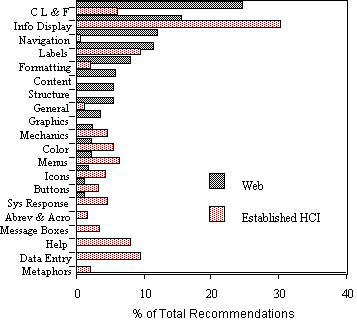
Figure 1. Distribution of Style Guide Recommendations
Across Categories