     
|


Taming Complexity at MAYA Design
Peter Lucas, Susan SalisMAYA Design Group, Inc.
2100 Wharton Street
Pittsburgh, PA 15203
412-488-2900
lucas@maya.com, salis@maya.com
|
|
MAYA Design is a full-service product design consultancy offering services at the intersection of computer science, psychology, and visual design. We have developed efficient techniques for facilitating interdisciplinary design and for communicating clearly with our clients.
There is a significant disparity between the state of the art in academic usability design and the average level of usability delivered to consumers. Despite a clear understanding of how to improve usability, hopelessly confusing technology products continue to hit the market daily. There is a solid consensus that interdisciplinary collaboration can vastly improve the usability and marketability of complex devices. There remains, however, a scarcity of commercial venues for interdisciplinary, user-centered design.
With the exception of a few superb in-house groups at large technology firms, there are very few opportunities in industry for careers that focus on meaningful interdisciplinary work. As a result, the best and brightest tend to gravitate toward academic work -- even if their interests are fundamentally oriented toward professional practice rather than research.
MAYA Design Group was founded in 1989 to address this problem. A spin-off of Carnegie Mellon University, MAYA was modeled after the great industrial design consultancies of the 1930s and 1940s. But it was built from the ground up as a place where engineers, human-factors specialists, graphic designers, and industrial designers could practice their disciplines in deep collaboration (Figure 1). This interdisciplinary collaboration allows MAYA to deliver a wide range of strategic, user-centered product- design services to the technology industries.
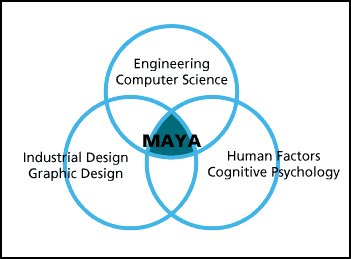
MAYA specializes in making complicated computer-based products easier for average people to use. Our goal is to "tame complexity," not necessarily to eliminate it. Our 23-member staff is more-or-less equally distributed among the three disciplines of engineering and computer science; human factors and cognitive psychology; and industrial and graphic design. We work closely with a diverse group of clients, primarily in the high-technology industries, augmenting their in-house capabilities with our areas of expertise.
We encourage clients to view MAYA as a "virtual employee" whom they can rely on for assistance throughout the whole product development cycle, which includes strategic planning, iterative design, rapid prototyping, user testing, and transition to manufacturing. Even when a project is focused on only one or two of our core competencies, our clients benefit from the easy communication among our specialists. For example, our graphic design staff would not deliver an icon design that is impossible to render given the color-map constraints of the target platform.
Every area of professional expertise has its own language, values, conventions, and perspectives on an issue. This diversity is the core value of collaborative process, but it is almost guaranteed to promote miscommunication, misperception, and misdirection. Add to this the development agenda and marketing needs of each client, and communication becomes a significant bottleneck. At MAYA, we focus on broadening the bandwidth of communication among all concerned, both between MAYA and the client, and among the other members of the client's team.
Making ideas concrete is central to MAYA's design approach. As early as possible, and throughout the design process, we use a variety of prototypes, depending on the scope of the project, timelines, and our client's budgetary constraints. These prototypes may be as simple as a storyboard, as concrete as a physical mock-up, or as detailed as a downsized, but fully architected, system. By giving early form to design ideas, prototypes also serve as a common language to express function, interaction style, aesthetics, and architecture.
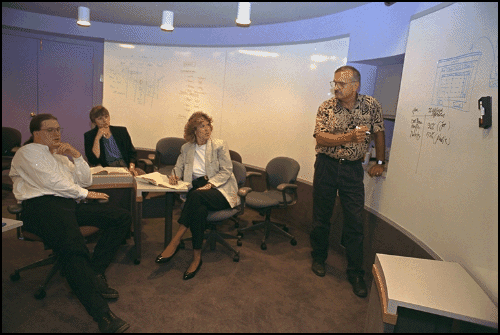
Brainstorming among our disciplinary specialists and with our clients is key to broadening the bandwidth of communication during a design project. MAYA's facilities include our kiva -- a multimedia brainstorming and presentation room inspired by the circular underground chambers used by the ancient Pueblo Indians (Figure 2). Our modern kiva has a wraparound white board that encourages team members to express their ideas in a free-form, non-hierarchical style of interaction. Instead of a fixed conference table, small curved tables, custom-designed by MAYA, line the perimeter of the room and can be wheeled about to accommodate users' needs. Our kiva includes a Macintosh 7100 PowerPC, a BARCO Video/Data large-screen projection system, a Panasonic VCR, and a Bose surround-sound system.
Informal communication among disciplinary specialists generates much good design. Our engineers, human-factors specialists, and visual designers mingle freely in a space configured in the "no walls" tradition of the design studio. Without divisive departments or office doors, our design team is free to exchange creative ideas and to discuss issues in a casual, uninhibited way.
Our user-studies lab enables us to collect and analyze user data. The lab also supports graphic design, video production, focus groups, and marketing presentations. Through a single computer interface, we can configure and control all of the equipment [1]. Our model shop facilitates production of prototypes or models of hardware products. Similarly, our engineering lab enables us to develop functional electronic prototypes making effective use of inexpensive microcontrollers and embedded systems technologies.
Working in the domain of Army logistics, MAYA and Carnegie Mellon University are developing a prototype software environment for accessing, analyzing, and visualizing large amounts of diverse data. Called Visage, this environment consists of three primary components: 1) a unique data navigation method using drill-down and roll-up techniques for navigating heterogeneous databases; 2) an information-centric drag-and-drop user-interface paradigm; and 3) the ubiquitous availability of intelligent visualization tools.
We are also collaborating with Digital Equipment Corporation to develop a clean-slate design for a new generation document-management product called Workscape* [2]. The product integrates diverse sources of information into a common 3-D display.
MAYA also has in its portfolio a diverse collection of physical product designs that complement our software design projects. These designs include control devices for consumer electronics and interactive video, the operator interface of a medical ultrasound device, the on-screen menu system for TVs and VCRs, and the engineering and industrial design for a modular, distributed control and home-automation system.
MAYA uses computer-solid-modeling techniques and stereolithography for the production of object prototypes and design for manufacture. For Solotec Corporation, MAYA was involved in all phases of the development of an innovative snowplow designed to be pushed by an automobile. 3-D computer models guided the visual and mechanical design of the product and were complemented by the construction of full-scale functional prototypes used for field trials. MAYA employs similar techniques for most of its 3-D products.
The authors would like to acknowledge Carolanne Fisher for her contributions to an earlier version of this paper.
*Workscape is a trademark of Digital Equipment Corporation.