



|
|
Ishantha Lokuge
MIT Media Lab
20 Ames Street
Cambridge, MA 02139
ishi@media.mit.edu
Stephen A. Gilbert
Department of Brain & Cognitive Sciences
MIT, E10-120
Cambridge, MA 02139
stephen@psyche.mit.edu
Whitman Richards
MIT Media Lab
20 Ames Street
Cambridge, MA 02139
whit@media.mit.edu
We all know that a curious person can more efficiently absorb information when it is well structured than when it is arbitrarily scattered. The question that every information architect then asks is, "How might I best organize the information for that person?" This question contains three issues: what structures are useful for organizing information in general, what structures are useful for organizing that information, and what structures are useful for organizing information for that person.
To answer these above questions, we propose (i) collecting experimental data from a number of subjects, (ii) analyzing the mental models of those subjects with Multidimensional Scaling (MDS) [7, 15, 16] and Trajectory Mapping (TM) [4, 9, 13], and then (iii) using those models to design information structures. Such models should lead more quickly to suitable interfaces rather than beginning with trial and error explorations.
Before continuing on to details, we offer definitions of "information structure" and "mental model." By "information structure" we mean an arrangement of pieces of information. The arrangement might be a 2-D array on a table or a screen, as in a card game or a spreadsheet. It might also be a 1-D ordering of items, like a shopping list. It could also consist of a set of information nodes with connecting association links, such as a hypertext. All the pieces of information should belong to the same conceptual type category, such as numbers to add, tasks to do, or words to remember. By "mental model" we mean not the explanatory model offered by Johnson-Laird [5], but rather a more general definition: the cognitive layout that a person uses to organize information in his or her memory.
Consider the map of Boston shown in Figure 1a. We have chosen fifteen different sites of activity taken from a tour guide book (listed in Figure 1b). This set of information pieces (or "stimuli," as we will call them) is a very high- dimensional in feature space, and it has a relatively large variance across people. That is, there are many features that can be used to describe the stimuli, and people do so in significantly different ways. As a contrasting example, a deck of playing cards contains very few features, namely the number of a card, its suit, and perhaps its color, and different people describe playing cards similarly.
 Figure 1a: Geographic layout of activities
 Figure 1b: The stimuli for the MDS and TM experiments.
A person who lives in Boston and knows the sites will have at least two mental
models of them, one based on their geographic locations, and one based on
their content. In order to illustrate the capabilities of Multidimensional Scaling
(MDS), first used by Torgerson [16], Shepard [15],
and Kruskal [7], we collected
data from two subjects for each of these mental models (Figure 3). Note that the
judgments based on geographic similarity (3a) are completely different from
judgments based on content (3b). The input data for MDS takes the form of
pairwise similarity judgments, and the output is an arrangement of the stimuli in
a metric space.
To clarify the procedure for obtaining these MDS plots, we offer a simple
example; consider a collection of seven black and white circles of different
sizes. In Figure 2a, these circles are arranged randomly along the edges of a
similarity matrix. The numbers show a subject's similarity rating on a scale of 1
to 7. From these numbers the MDS algorithm arranges the circles as shown in
Figure 4, with neighboring circles being the most similar.
The distances between the points in the output is usually a non-linear
transformation of the values in the similarity matrix. For Figure 3a, we asked the
subjects for every pair of stimuli, "On a scale from 1 to 7, how similar are stimuli
X and Y in terms of their distance from each other?" For Figure 3b, we asked,
"How similar are stimuli X and Y in terms of their content or theme?" We then
used KYST2 [6] to run the MDS and generate the graphs shown.
As one might expect, the distance-based MDS plot is similar to the actual map
of Boston, though somewhat warped; the warping could stem from differing
familiarity with the sites [11] or from thinking of distance as travel time instead of
geographic distance. In the content-based MDS plot, similar activity sites like
the Aquarium and the Zoo appear near each other, as do shopping areas
Newbury Street and Quincy Market. One can use the groupings of points in an
MDS plot to assign features to clusters of points, as we have done in Figure 3b
with the features, "historical," etc. Likewise, many researchers who use MDS
would attempt to assign meaning to the axes of the plot, suggesting perhaps
that the X-axis runs from "playful to serious" and Y-axis runs from "outdoors to
indoors". Such labels or category assignments must be done carefully and
should be verified with separate experiments, however, because they are often
biased by the experimenter's a priori knowledge of the data.
The reader might wonder what would be the outcome if we had asked subjects
to give general similarity ratings without specifying what type of similarity.
Would the resulting MDS plot have been an unfortunate mixture of the two plots
in Figure 3? This issue raises the question of how we could have known what
types of similarity to separate if we knew nothing about the data to begin with.
To answer this question, we introduce the relatively new Trajectory Mapping
(TM) procedure [4, 13, 14].
For high-dimensional feature spaces, often TM can better delineate the features
of the data than MDS. Instead of giving similarity judgements as in MDS, the
subject's task in TM is to imagine a conceptual feature or property that links a
given pair of stimuli. The subject then extrapolates that feature in both
directions to pick two stimuli from the remaining set that would be appropriate.
The subject also picks an interpolant, i.e. a stimulus that would fit well within the
pair.
Returning to our black and white circle example, a TM set of input data might
appear as in Figure 2b. The members of the original pair are in columns A and
B; the extrapolants are in the two "ex" columns, and the interpolant in the "int"
column. As well as using a stimulus for each slot, the subject may also enter an
"X" or a "...". An "X" indicates that the subject did not feel comfortable choosing
a stimulus for that spot, and the "..." indicates that the subject could imagine a
stimulus that would fit there, but that such a stimulus was not present in the
given data set to choose from.
From this set of quintuples, we can now extract a connected graph of the stimuli
in which the maximum number of quintuples fit. For example, in the top row of
Figure 2b, we have an ordered set of white circles ending in a small dot in one
column, and a set of black circles ending in the same small dot in the other
column. If these quintuples are equally considered as constraints on the graph,
the ending trajectory map will contain a path from the large white circle to the
large black circle, going through the small dot, as shown in Figure 4.
Figure 5 shows a trajectory map for tourist site data gathered from the authors.
Note here that the positions of the nodes are not important; the mental model
lies in the connections between the nodes, i.e. the topology of the graph. The
weights on the links are based not on similarity, but rather on the robustness of
that link across a gamut of parameters within the TM algorithm. The weight on a
link can thus be thought of as the strength of the connection in the mental
model. (A TM algorithm is being fine-tuned for release by Gilbert.)
By pruning the trajectory map to only its strongest links, one can see rough
feature clusters emerge (see the heavier links in Figure 5). In our example, the
clusters are roughly similar to the estimated clusters in the MDS plot (Figure 2b).
In a trajectory map, however, the stimuli are ordered within each cluster, e.g.
Arboretum, Swan Boats, Aquarium/Zoo. Figure 6 shows the combined mental
models, a rough TM path drawn over the MDS content-based plot.
Because the tourist sites have several possible features that could be used by
subjects to report their TM extrapolations and interpolations, one can discover
the most salient features of the data set by running the algorithm across many
subjects. It is likely with this tourist site information, for example, that some
subjects would do the TM based on geographic distance, while others would do
it based on the content of the sites. This feature difference would eventually
manifest itself from obviously disparate trajectory maps, and lead to the
phrasing of the MDS questions described earlier: similarity in terms of distance
and similarity in terms of content. Examples of different trajectory maps for the
same domain can be seen in [12].
The mental models from TM and MDS provide an excellent basis for measuring
the efficiency of an information structure that has been built from the models.
One might arrange the stimuli serially according to the TM paths or distribute
them according to the MDS plot. After collecting data from a new pool of
subjects for measures of readability, ease of remembering, etc. (see [2, 3] for a
typical array of memory measures), the information structure can be
systematically varied by changing the parameters that produce the MDS and
TM models.
If one considers the set of tourist attractions as an information space to be
explored, we can also use the mental models to give the user well-founded
suggestions as to his or her next step of exploration. As a demonstration of
feasibility, we have designed a visualization system that allows the exploration
of the Boston tourist attractions. Since we are no longer restrained to the
geography of Boston, as an actual tourist would be, we must now answer the
question, "How should we order the various sites?" To explore the different
possible answers, we have built three different interfaces for the system, each of
which defines an "attentional window" as the current region of interest in the
information space. An activation spreading network based on the mental
models defines the size of the attentional window as the user explores. Thus, if
the aquarium node of the network is currently activated, and the models suggest
that the swan boats node is closely related, then the activation will spread to
swan boats, leading the attentional window to include swan boats as a potential
next focus.
In the first two interfaces, the 15 sites are arranged two-dimensionally according
to the MDS plot in Figure 3b. Whichever sites fall within the attentional window
are rendered larger than the others. In one interface, the attentional window
envelops MDS regions (Figure 7), and in the other, the window spreads across
TM paths (Figure 8). Figure 7a shows the display of regional activation with
emphasis on children's activities. Figure 7b shows the activities in an adult
context. In contrast, Figure 8 shows several successive frames of path
activation: when the user investigates the Sports Museum, the network
suggests that Fenway Park or the Children's Museum might be a good next
choice (those two sites are slightly enlarged in Figure 8a). As the user shifts
attention to the next event, past activities fade away and activities further along
the path become more conspicuous.
The difference between these two styles of exploration can be characterized by
the width of the attentional window: narrow in the case of paths, and wide in the
case of regions. By smoothly varying the width, one might change smoothly
between modes of exploration.
The third interface attempts to combine the path and region following ideas of
the first two. This interface depicts the sites as semitransparent multimedia
cubes in a 3-D space (Figure 9). The cubes are arranged along the TM paths,
but at each cube, other cubes within the same region can be seen orbiting the
current cube nearby. Thus, the user can "fly" smoothly through the space along
the TM routes, or branch off to a similar site within the current region. Also, the
floor of each cube displays a geographic map with the site's location high-
lighted, thus incorporating all of the features that we have discussed thus far.
The activation spreading network was designed by Lokuge and Ishizaki [10],
and the visualization system is implemented on a Silicon Graphics Onyx
workstation [8]. This network links nodes in a space (Figure 10) and uses the
ordering in the space to control the activation level of a node [1, 12]. When
attention "jumps" to a new node, the network partially reduces the activation
levels in the original set of nodes, leaving a faint trace as a history of the
attentional sequence.
We have designed this visualization system with its various interfaces both as
an existence proof that such a system could be devised and as an illustration of
our proposed methodology for structuring information. We mentioned above
the fact that a variety of mental maps exist for each data set, both within and
across individuals. A further development would be an intelligent activation
spreading network, i.e. one which contained the full repertoire of different
mental models for a given data set and chose the best model based on the
user's behavior. Such a repertoire could be described as a "hyper-mental-map"
and could likely formed by gathering MDS and TM data on the mental models
as stimuli themselves.
We have proposed and implemented a method of organizing information space
around cognitive maps. We plan next to explore the degree to which this
method can be used with more generalized domains of knowledge, but
examples from previous MDS and TM papers lends us hope that the method
could become generally applicable. By accommodating an individual's search
context (e.g. through paths or regions) and his or her particular model of a
domain (e.g. a particular MDS or TM model), one can offer both a more
personalized tour of the information space and a more easily absorbable mass
of information.
This work was in part sponsored by ARPA, JNIDS, NYNEX and Alenia.
However, the views and conclusions expressed here are those of the authors
and do not necessarily represent that of the sponsors.
5. Johnson-Laird, P.N. Mental models. Cambridge, MA: Harvard University
Press, 1983.
6. Kruskal, J.B. kyst2a. AT&T Bell Laboratories, Computing Science Research
Center, Netlib repository of software. http://plan9.att.com/netlib/mds/index.html.
11. Lynch, K. Image of the City. Cambridge, MA: MIT Press, 1960.
16. Torgerson, W.S. Multidimensional scaling: I. Theory and method.
Psychometrika, 4, 401-419, 1952.
MDS AND TM METHODS
 Figure 2a: Typical input data for the MDS algorithm; similarity data for black and white
circles of different sizes.
7 = very similar; 1 = very dissimilar.
Figure 2a: Typical input data for the MDS algorithm; similarity data for black and white
circles of different sizes.
7 = very similar; 1 = very dissimilar. Figure 2b: Typical input data for the TM algorithm; extrapolations and interpolations for
black and white circles of different sizes. Here are 12 of 21 possible pairs.
Figure 2b: Typical input data for the TM algorithm; extrapolations and interpolations for
black and white circles of different sizes. Here are 12 of 21 possible pairs. Figure 3a: MDS plot based on geographic similarity
 Figure 3b: MDS plot based on content similarity
 Figure 4: MDS and TM output for black and white circles.
BOSTON DATA
 Figure 5:Trajectory map for the tourist site data
 Figure 6:The mental models combined: a rough TM path superimposed over the MDS
content plot.
Figure 6:The mental models combined: a rough TM path superimposed over the MDS
content plot.
EXPERIMENTATION
EXAMPLE INTERFACES
 Figure 7a: Children's activities energized by the regional activation spreading network.
 Figure 7b: Adults' activities energized by the regional activation spreading network.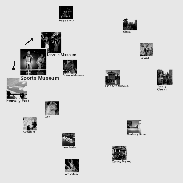

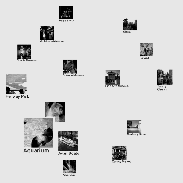
Figure 8:
The network activates the path segments when the user examines the sites Sports
Museum, Fenway Park and Aquarium. The activation levels are mapped to image and
typographic size, enabling the system to suggest to the user an appropriate next step based
on the MDS and TM results.
Figure 9:
An interface that combines path and region following; the sites are represented by
cubes in a 3-D space. The cubes lie along the TM paths, and the other sites from the MDS
region encircle the cube within the attentional window.


 Figure 10: Schematic diagram of a regional activation spreading network.
Activation
energy spreads in the direction of the arrows initiated by the Goal: Kids' Tour of Boston.
Figure 10: Schematic diagram of a regional activation spreading network.
Activation
energy spreads in the direction of the arrows initiated by the Goal: Kids' Tour of Boston.DISCUSSION
Acknowledgments
References
